New AI Features in Productivity Software: What Changed in 2026
Productivity software changed a lot this year. The big shift? AI stopped just answering questions. Now it does the work. New...
Gadgets & Technologies Are Together
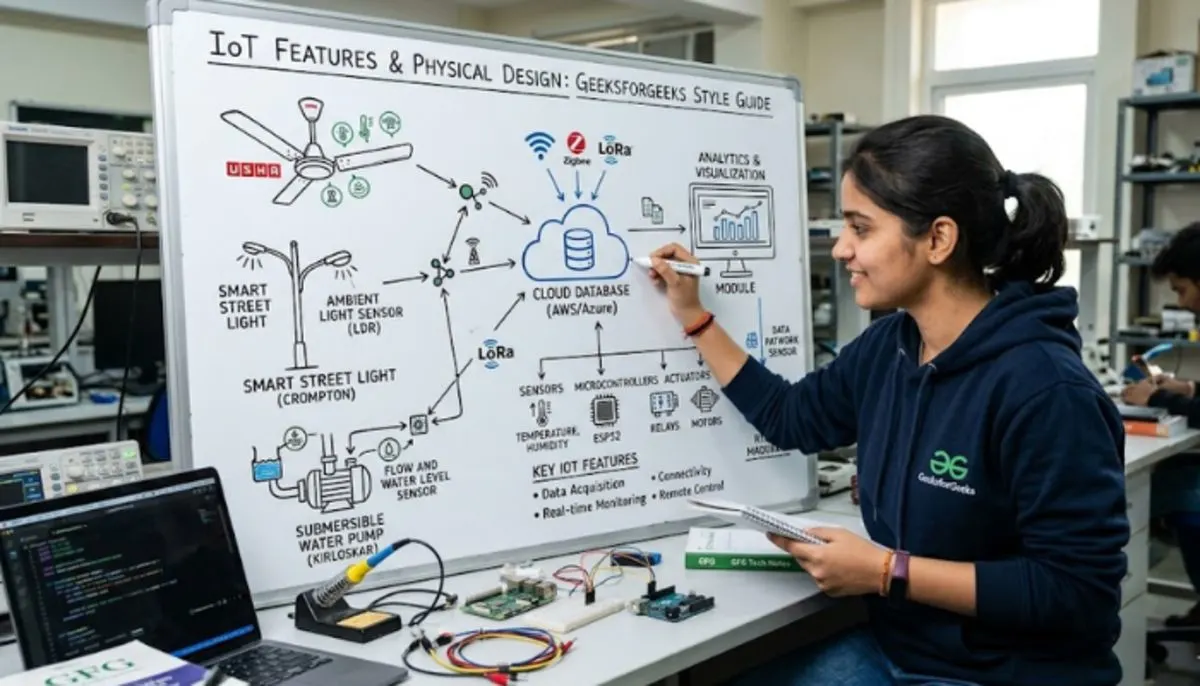
If you are a student in India, you have probably visited GeeksforGeeks to understand computer topics. One topic that comes again and again in college exams and job interviews is IoT. IoT stands for (Internet of Things). It sounds big and hard, but it is actually very simple. IoT means taking normal things around you like a fan, a bulb, a water motor, or even a cow and putting a small electronic chip inside them.
Once that chip is there, that thing can connect to the internet. And once it connects to the internet, you can talk to it from anywhere. You can ask it to turn on. You can ask it to send you data. You can even ask it to take a small decision by itself. In this article, we will explain all the IoT Features Explained GeeksforGeeks Style. We will also look at the physical design of IoT.
IoT is a network of physical things. These things are not computers or phones. They are everyday objects like fans, lights, air conditioners, water pumps, and even cattle. But these things have small electronic parts inside. These parts let them connect to the internet. Once connected, you can control them from far away. You can also collect data from them.
For example, a farmer in Punjab can put a small device on his motor pump. That device connects to the internet. The farmer can then turn the pump on or off from his phone sitting at home. This is IoT.
So the full meaning of IoT is this: any physical object that can send and receive data over the internet without a human typing or clicking every time.
Read More: Digital Transformation Features 2026: Key Trends Shaping Indian Businesses
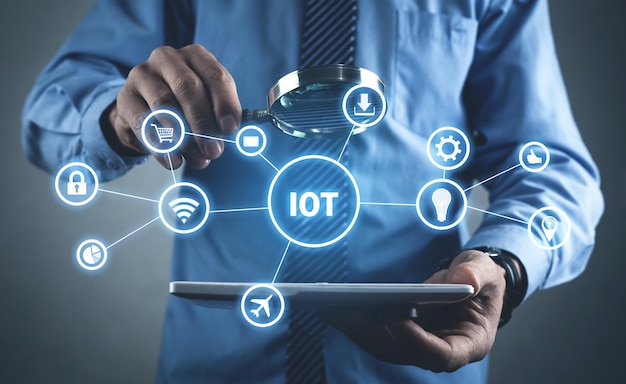
In India, IoT is used in many government projects. Smart city projects in Ahmedabad, Pune, and Chennai use IoT. Also, many private companies like Tata, Infosys, and Reliance Jio are hiring IoT engineers. In college exams and in interviews, the first question is always: tell me the features of IoT. If you do not know the features, you cannot answer further questions.
Also, GeeksforGeeks has a very popular section on IoT. When you search "IoT features explained geeksforgeeks", you want a clear answer. This article gives that clear answer.
Before we list the features, we need to understand the physical design of IoT. GeeksforGeeks teaches that IoT has two main parts in its physical design. The first part is the hardware. The second part is the software or the way things connect.
These are the actual things you can touch. A small temperature sensor. A light bulb that works on wifi. A smart lock on a door. In Indian terms, think of a smart water heater. The hardware has three small parts inside:
The device cannot work alone. It needs a path to send data. This path is called the communication layer. In the physical design of IoT, this layer is very important. There are different ways:
So when GeeksforGeeks explains physical design of IoT, they always say: first the device, then the network. Without both, there is no IoT.
Now we come to the most important part. These are the features of IoT. Every good article on "IoT features explained" must cover these. Read each feature slowly. Think of an Indian example for each.
The first and most basic feature is connection. Every IoT device must connect to a network. Without connection, it is just a normal thing. A normal fan does not connect. An IoT fan connects to your phone through wifi. This connection can be always on or only when needed. But it must be there.
Indian example – A smart plug from Amazon or Flipkart. You put it in your home socket. You connect it to wifi. Then you can turn off your room heater from office.
An IoT device can sense its surroundings. This is because of the sensor inside. Sensors collect real data from the real world. This data is not typed by a human. It is collected automatically.
Indian example – A water tank sensor in a Delhi apartment. It tells you on your phone how much water is left. You do not have to open the tank and check.
Intelligence means the device can take small decisions on its own. It does not need to send every small thing to a big computer. The small processor inside does basic thinking. This saves time and internet data.
Indian example – A smart street light in Bangalore. It has a light sensor. When evening comes, the light turns on by itself. When morning comes, it turns off. No person is needed.
Old devices only collect data and store it. But IoT devices exchange data actively. They send data to a server. And they also receive commands from a server or from your phone. This two-way talk is a key feature of IoT.
Indian example – Your smartwatch. It sends your heart rate to the phone. But the phone also sends a message to your watch to remind you to walk.
Scalability is a big word but it has a simple meaning. It means you can add more and more devices without breaking the system. You can start with two smart bulbs in your room. Later you can add ten more bulbs and five fans. The system should still work.
Indian example – A farmer starts with one soil moisture sensor. It works. Then he buys fifty more sensors for his whole farm. The same software works for fifty sensors. That is scalability.
Heterogeneity means different types of devices can work together. One device can be a temperature sensor made by company A. Another device can be a motion sensor made by company B. Still they can connect and share data. They do not have to be the same brand.
Indian example – In a smart home, you have a Xiaomi camera, a Philips bulb, and a local Indian brand smart plug. All three work from the same Google Home app. That is heterogeneity.
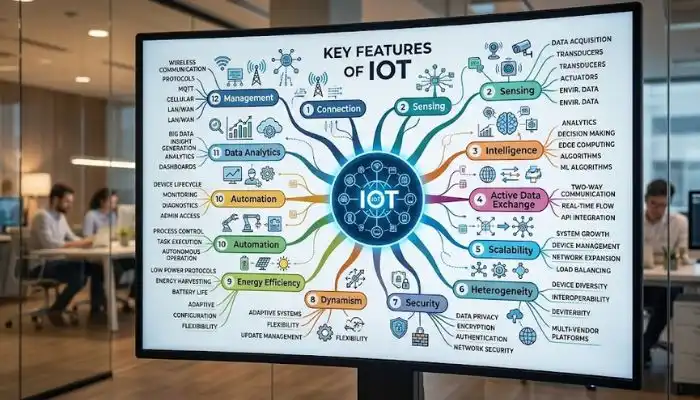
Security is a very important feature of IoT. Because IoT devices are on the internet, bad people can try to hack them. A good IoT system has security features like data encryption and user login. Without security, IoT is dangerous.
Indian example – A smart door lock. Only the family members have the app password. The lock sends an alert if someone tries to open it without permission.
You do not have to be near the device to use it. You can be in another city or another country. As long as you have internet, you can control your IoT device. This is called remote control.
Indian example – An NRI son living in America can check the CCTV camera of his parents' house in Kerala. He can also turn on the water motor if needed.
IoT gives data as it happens. Not after one hour or one day. Right at that moment. This is called real time data. It is very useful for emergencies.
Indian example – A gas leakage sensor in a Mumbai kitchen. The moment gas leaks, the sensor sends a real time alert to the owner's phone. The owner can call the family to open windows.
IoT devices have become very cheap. Earlier only big companies could use IoT. Now even a small shop owner in India can buy IoT devices. The cost of sensors and chips has come down a lot.
Indian example – A small tea seller in Indore puts a small GPS device on his bicycle. He pays only five hundred rupees. Now he can see his bicycle location on phone.
Many IoT devices run on battery. They are made to use very little power. Some devices can run for months on one small battery. This is very important for places where there is no electric line.
Indian example – A soil moisture sensor in a remote Maharashtra village. No electric pole nearby. But the sensor runs on a small battery for six months.
The last feature is ease of use. A good IoT device has a simple mobile app. Any person can use it. You do not need to know coding or networking. You just install the app, add the device, and start.
Indian example – A grandmother in Lucknow uses a smart plug to turn on her temple light. She just says "Ok Google, light on". No training needed.
Let us take one full Indian example. A school in a village in Bihar. The school gets very hot in summer. The principal buys an IoT fan and an IoT temperature sensor.
This is how the features of IoT work together.
Many students ask: what is the real difference? Here is a simple answer.
A normal fan has only one feature: it rotates when you turn the switch. That is all.
An IoT fan has many features. It rotates. It senses if the room is empty and turns off. It sends data to your phone. It works with your voice. It can be turned on from another city. It can be part of a group of fans.
So IoT adds new features to old objects. This is the whole point of IoT.
You May Also Read: Best Keyword Research Tool for Content Creators (Free Options Inside)
The features of IoT are not just for passing exams. They are the building blocks of every smart device made today. When you understand these features, you can design your own small IoT projects. You can also answer any question in an interview. The physical design of IoT is the base. The features are the working parts. Together they make the Internet of Things.
If you are preparing for GATE or campus placements, save this article. Read it once a week. After some time, you will be able to explain IoT features to anyone in simple words. And that is the real test of knowledge.
No, IoT is not hard. You do not need to be a coding expert to understand the basic features. Many parts of IoT are about common sense. For example, sensing means the device feels heat or motion. Connection means the device talks to the internet. You already use these things in daily life. A first year college student in India can learn IoT features in one week. Start with the physical design. Then learn each feature slowly. Do not jump to coding directly.
2. Can I make a small IoT project at home without spending too much money?
Yes. Many Indian students make IoT projects for under one thousand rupees. You need a small board called NodeMCU or ESP8266. You can buy it on Amazon or Flipkart for four hundred to five hundred rupees. Then you need one sensor like a DHT11 for temperature. That costs two hundred rupees. Then you need a few wires. Total cost is less than one thousand rupees. You can connect this to your phone and see temperature data. This is a real IoT project. No need for expensive things.
3. What is the difference between physical design of IoT and features of IoT?
Physical design means the real parts you can touch. These are the device, the sensor, the processor, and the communication chip. Features of IoT means what the device can do. For example, a smart bulb has a physical design that includes a LED light and a wifi chip. The features of that same bulb are connection, remote control, and low energy use. You need physical design to have features. But features are the actions. Physical design is the body. Features are the work the body does.
4. Why does GeeksforGeeks explain IoT features in so much detail?
GeeksforGeeks is a website for Indian students who are preparing for campus placements and technical interviews. In interviews, the person asking questions wants to know if you understand the basic ideas deeply. They do not want a one line answer. They want you to explain each feature with a real example. GeeksforGeeks gives that depth. That is why their IoT content is long and detailed. It helps you get the job.
5. Will these IoT features change in the next five years?
The basic features will not change. Connection, sensing, intelligence, security, remote control – these will always be needed. New technology will make these features better and cheaper. For example, security features will become stronger. But the core list of features will stay the same. So if you learn these twelve features today, they will still be useful five years from now. Do not worry about the future. Learn the basics well. Then you can understand any new IoT device that comes to the market.