Enterprise CRM for Global Companies: Best Platforms in 2026
Global companies face challenges smaller businesses do not. Data residency laws. Multi-currency transactions. Multilingual teams. Regional compliance. A CRM that...
Gadgets & Technologies Are Together

India is serious about artificial intelligence. The government launched the India AI Mission in March 2024 with Rs 10,371 crore funding. The mission has seven pillars covering compute, data, innovation, skills, and startups. India AI Mission latest news shows a major shift. Instead of chasing billion-parameter models, India is focusing on small, practical AI.
The country now has 62,000 GPUs deployed. The India AI Compute Portal gives researchers subsidised access. The India AI Impact Summit 2026 brought global attention. The focus of the mission is to create applications for agriculture, health and education. This article is about the new changes, hurdles, and the future of AI in Indi
The India AI Mission was approved by the Cabinet in March 2024 with a budget of Rs 10,371.92 crore over five years . The goal was clear: make AI work for India, not just copy what the West is doing.
The mission has seven pillars: compute infrastructure, data platforms, foundational models, application development, skills, startup funding, and safe and trusted AI .
Read More: Latest SaaS Industry News: Key Trends and Updates for 2026

At the India AI Impact Summit 2026 in New Delhi, the government made a surprising announcement. Instead of showing off a massive trillion-parameter model, they talked about small models .
Union Minister Ashwini Vaishnaw said something that caught everyone off guard: "Global 95% of AI work only needs small models." In India, models with 10 billion to a few hundred billion parameters are enough for most business needs .
This was a major shift. India is no longer trying to match OpenAI or Google on raw scale. Instead, they are focusing on practical, local solutions.
Here is what the seven pillars actually do :
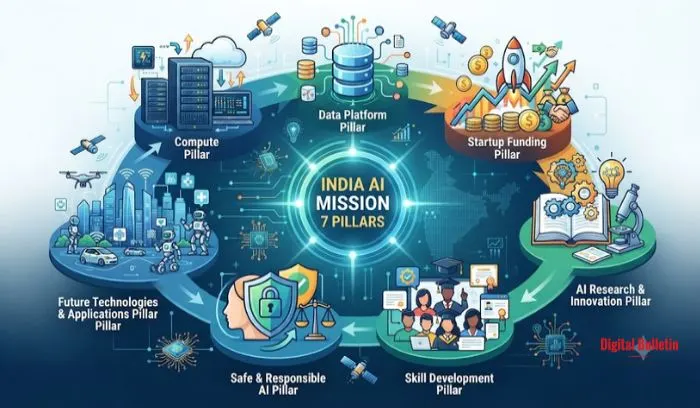
The India AI Compute Portal is one of the mission's key achievements. Instead of buying expensive cloud compute from foreign providers, Indian researchers and startups can now access subsidised GPUs .
The number of GPUs has grown fast. From fewer than 500 GPUs just two years ago, the mission has deployed 62,000 GPUs . This is a massive leap.
The India AI Impact Summit 2026 was a turning point. Over five days in New Delhi, the event showcased India's AI ambitions .
Key announcements included :
India's AI mission is ambitious, but there are real hurdles .
India's roadmap is divided into clear phases :
You May Read Also: Quantum Computing News 2026: India and Global Advances
The India AI Mission latest news shows a country that is serious about AI. The mission has moved from policy to execution. GPUs are being deployed. Indigenous models are being built. Training programs are being launched.
The shift to small models is a smart move. Instead of trying to beat the West at their own game, India is focusing on practical solutions for its own population. The challenges are real, but the momentum is undeniable. India is building its own AI future.
It is a government program launched in March 2024 with Rs 10,371 crore funding over five years. The mission aims to build AI infrastructure, develop indigenous models, and create jobs in AI across India.
AI Compute, Innovation Hub, Data Platform, Application Development, Future Skills, Startup Funding, and Safe and Trusted AI. Each pillar targets a specific gap in India's AI ecosystem.
It is a platform that gives researchers and startups access to subsidised GPUs. India now has 62,000 GPUs deployed under the mission, up from fewer than 500 just two years ago.
India is focusing on small models, not billion-parameter giants. The government believes 95% of AI work can be done with models under 100 billion parameters. This is a strategic shift announced at the India AI Impact Summit 2026.
Skills gap, talent retention, and compute constraints. India produces 1.5 million engineers a year, but less than 5% have worked with AI. The mission is working on training programs to bridge this gap.
March 2024. The Cabinet approved the mission with a budget of Rs 10,371.92 crore over five years.
62,000 GPUs as of March 2026. The target is to reach 200,000 GPUs eventually.
AIKosh is a national data platform that provides clean, AI-ready datasets in 22 Indian languages. It is designed to help Indian researchers build models that understand local contexts.