Latest Tech News and Updates: AI, 6G and Major Deals
The tech world does not slow down. This week brought major developments across AI safety, next-generation networks, and billion-dollar acquisitions....
Gadgets & Technologies Are Together

Businesses today face a choice. Move everything to the public cloud. Keep everything on-premises Or find a middle ground. That middle ground is hybrid cloud. It combines the control of private infrastructure with the scale of public cloud and it is now the dominant model for enterprises worldwide.
This guide explains Hybrid cloud solutions for businesses are the benefits and drawbacks, and the best options for businesses in 2026.
A hybrid cloud combines private infrastructure (on-premises data centers or private cloud) with public cloud services like Microsoft Azure, AWS, or Google Cloud . Applications and data can move between these environments as needed.
The key difference from multi-cloud is integration. Multi-cloud means using multiple public clouds side by side. Hybrid cloud means connecting private and public environments into one unified system .
Simple example: A bank keeps customer account data in its own data center for compliance. It uses public cloud for marketing analytics and mobile app hosting. The two environments talk to each other securely. That is hybrid cloud.
Read More: Blockchain Technology Trends News: Tokenization Goes Mainstream in 2026
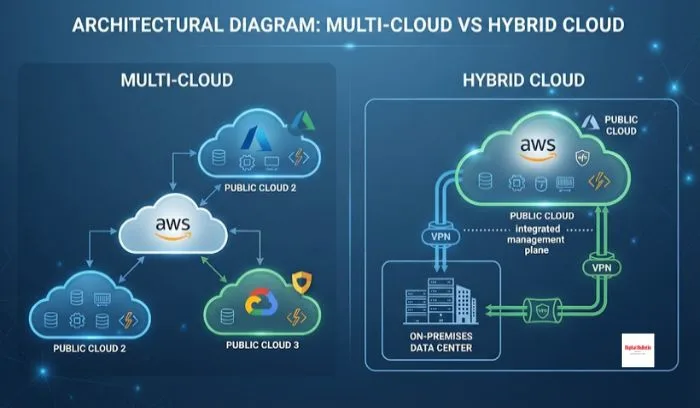
Hybrid cloud is no longer a temporary stepping stone. It is the destination. According to Flexera's 2026 State of the Cloud Report, 73% of organizations now operate hybrid estates. That is up three percentage points from last year .
The reasons vary. Mergers and acquisitions create mixed environments. Different workloads have different needs. Some applications are too expensive to migrate. Others cannot move for compliance reasons .
In India, the shift is even more pronounced. A Forrester report found that 96% of Indian enterprises operate a hybrid cloud strategy . The market has moved from migration to managing complex environments.
Several platforms lead the market. Each has strengths for different use cases.
Microsoft offers the most comprehensive hybrid management platform. Azure Arc applies Azure policies and services to any infrastructure—on-premises, edge, or even resources hosted on AWS or Google Cloud . Azure Stack runs Azure services on-premises.
Best for: Microsoft ecosystems and highly distributed environments requiring unified governance.
AWS Outposts extends AWS infrastructure and services on-premises or to colocation facilities. You get native AWS services (compute, EBS, S3) with the same APIs and tools as the public cloud .
Best for: Organizations already invested in AWS that want a consistent extension to on-premises.
Google Distributed Cloud (GDC) extends Google Cloud services to on-premises, edge, and other clouds. Its DNA is heavily container and Kubernetes oriented, with strengths in data and AI .
Best for: Cloud-native organizations deploying containerized applications from cloud to regional edge.
OpenShift is an enterprise Kubernetes platform independent of hyperscalers. It runs anywhere—on-premises, edge, or any public cloud .
Best for: Container-first, multi-cloud strategies where portability and neutrality matter.
VMware Cloud Foundation provides a hybrid virtualization foundation. It offers continuity for existing virtualized environments .
Best for: Organizations with established VMware deployments across private sites and edge.
Best for: Regulated industries needing sovereign, compliant, AI-ready environments.
Indian enterprises are moving fast on hybrid cloud. Forrester's report shows 96% operate hybrid strategies .
Key priorities for Indian enterprises:
Resilience: 68% cite improving resilience across cloud platforms as a top priority
Skills: 66% point to developing cloud skill sets
Data governance: 64% rank data governance and management as critical
Connectivity: 63% say better cloud connectivity is a top priority
Spending discipline is also maturing. 67% of enterprise cloud decision-makers have an established FinOps practice, with another 18% planning to adopt one within 12 months .
AI is influencing workload placement. 30% of respondents are investing in AI, ML, and generative AI through public cloud providers. But enterprises are reassessing whether all AI workloads belong in public cloud due to cost, resource availability, and performance concerns .
Sensitive workloads continue to stay on-premises or move to private cloud because of data sensitivity, regulatory obligations, and licensing limits .
Hybrid cloud solutions for businesses are no longer optional. They are the standard. 73% of organizations globally and 96% in India operate hybrid estates .
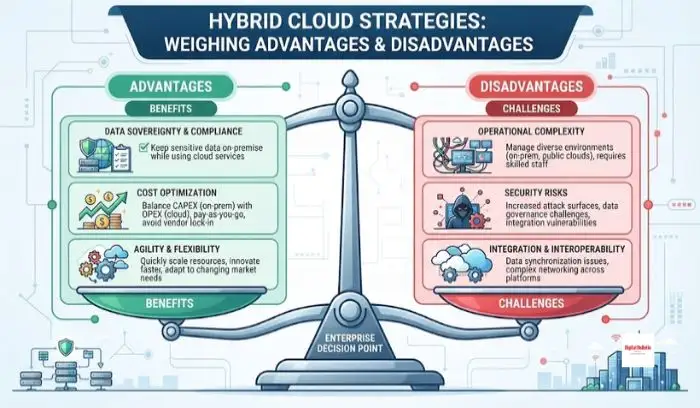
The benefits are clear: data sovereignty, cost optimization, flexibility, and access to innovation. The challenges are real: complexity, security, and network dependencies. But these are manageable with the right platform and skills.
Choose the solution that fits your ecosystem. Azure Arc for Microsoft. AWS Outposts for AWS. Google Distributed Cloud for container-native. DXC Private Cloud+ for regulated industries. Start with your compliance and performance needs. The rest follows.
Your own servers plus public cloud. Working together. Private data stays private. Public cloud handles the rest. One setup.
Data stays where it should. Costs can go down. Move at your own speed. Better backup. Get new tech like AI. Control and scale.
Harder to manage. More ways in for attackers. Needs a solid network. Costs creep up if you do not watch. Needs skilled people.
Hybrid mixes private and public. Multi-cloud uses several public clouds. Many firms do both. Depends on your rules.
Depends what you already run. Azure Arc for Microsoft. AWS Outposts for AWS. Google Distributed Cloud for containers. OpenShift for portability. DXC Private Cloud+ for regulated sectors.
Very. 73% of companies worldwide. 96% in India. It is the norm now.
Complexity. Different tools. Different systems. Keeping security same everywhere. You need good people and a strong network.
Put AI where it works best. Train on public cloud GPUs. Run predictions on-site for speed. Keep sensitive data private. That is why AI is driving hybrid cloud.