Which Technology Is Trending Today? Top Tech Trends 2026
Technology moves fast. What was hot last year is old news now. The question "which technology is trending today" has...
Gadgets & Technologies Are Together

Blockchain technology trends news in 2026 shows a clear shift. The era of experimentation is over. Major financial institutions are now moving real assets onto blockchain rails.
From UK banks settling interbank transactions with tokenized deposits to Circle launching its institutional Layer 1 blockchain, blockchain is becoming part of mainstream finance. This article covers the biggest trends shaping blockchain technology today.
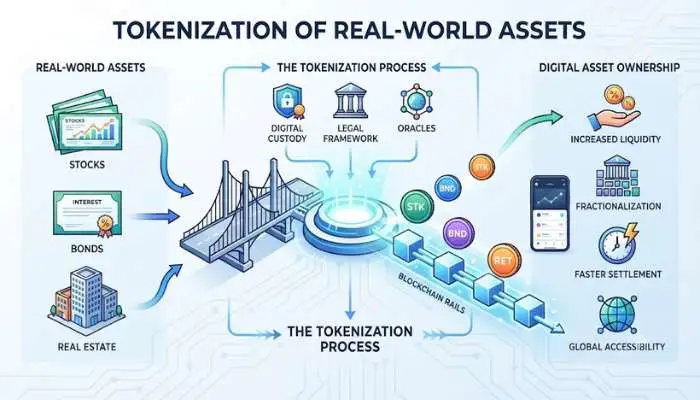
Tokenization is the biggest story in blockchain right now. It means creating digital tokens on a blockchain that represent traditional assets like stocks, bonds, and real estate.
Read More: India AI Mission Latest News: Small Models and AI Growth
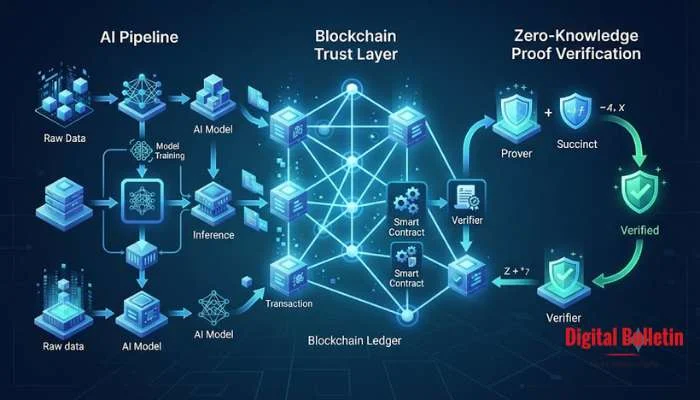
The intersection of blockchain and AI is becoming a major trend. Blockchain is being positioned as the trust layer for AI systems.
According to IEEE's 2026 editorial, blockchain is becoming vital infrastructure for "Verifiable AI Pipelines." Data sourcing, training, and inference can be cryptographically anchored to ensure provenance and prevent model compromise .
The standard for reliable enterprise AI now involves three critical functions anchored to blockchain:
Provable Data Integrity: Using Merkle Trees to ensure training datasets cannot be altered
Verifiable Compute: Using Zero-Knowledge Proofs to prove model correctness
Immutable Event Trails: Logging automated decisions in a tamper-proof record
OVHcloud research found that 27% of Web3 professionals believe blockchain can improve AI explicability and traceability. Another 61% cited federated learning, where data is shared between machine learning platforms without exposing underlying datasets .
The blockchain industry is moving from pilot projects to production-grade infrastructure.
LayerZero introduced a new blockchain called Zero, designed for global financial markets. It claims capacity of up to 2 million transactions per second. Partners include DTCC, ICE, Google Cloud, and Citadel Securities. ARK Invest's Cathie Wood joined the advisory board .
With quantum computing advancing, traditional encryption faces existential risks. 2026 is a critical inflection point following the finalization of NIST standards for post-quantum cryptography. Organizations must manage "harvest now, decrypt later" threats by adopting hybrid cryptographic architectures .
The scalability dilemma is being addressed through Layer 2 solutions, sharding, and new consensus mechanisms entering high-transaction production environments .
You May Also Read: Latest AI Developments in India 2026: Key AI Growth
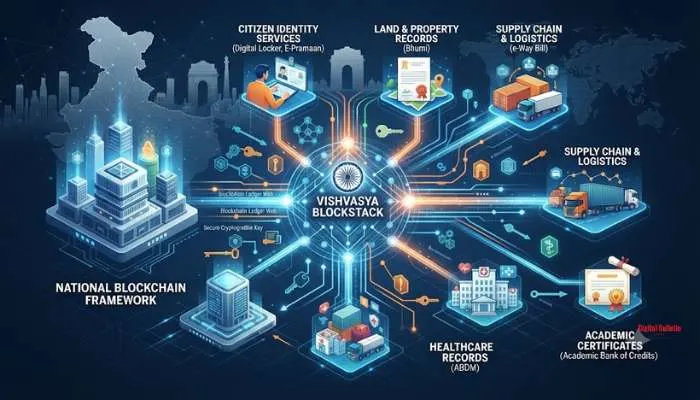
India is taking a structured approach to blockchain adoption, focusing on governance and public services.
The Ministry of Electronics and Information Technology (MeitY) formulated a National Blockchain Strategy to foster adoption across sectors. The framework includes the Vishvasya Blockchain Stack, providing architecture for permissioned blockchains and Blockchain-as-a-Service offerings .
The Reserve Bank of India is leveraging blockchain for the Digital Rupee pilot, launched in December 2022. It demonstrates how blockchain enables instant, traceable, and transparent payments .
Blockchain technology trends in 2026 show a technology that has matured. Tokenization is bringing real assets onto blockchain rails. Major financial institutions are building and using institutional-grade infrastructure. AI and blockchain are converging to create verifiable, auditable systems.
In India, the government is embedding blockchain into public digital infrastructure. Document verification, land records, medicine tracking, and judicial processes are being secured on distributed ledgers.
The question is no longer whether blockchain will be adopted. It is how fast institutions can adapt. The infrastructure is ready. The applications are live. The future is being built on-chain.
Tokenization. Real-world assets like stocks, bonds, and deposits are moving onto blockchain rails. NYSE is exploring tokenized stocks. Circle launched Arc for institutional finance. UK banks completed first interbank tokenized deposit transactions.
Blockchain is becoming the trust layer for AI. It provides provable data integrity, verifiable compute, and immutable event trails. This ensures AI systems can be audited and their decisions traced.
A tokenized deposit is a bank liability recorded on a blockchain. Unlike stablecoins issued by private companies, tokenized deposits keep money on the bank's balance sheet. They allow 24/7 movement of regulated money.
It is MeitY's strategy for blockchain adoption across government sectors. It includes the Vishvasya Blockchain Stack for permissioned blockchains and Blockchain-as-a-Service. It supports document verification, land records, supply chain tracking, and more.
A MeitY initiative launched in February 2026. It funds DPIIT-recognised startups to develop permissioned blockchain solutions for government use cases. Ten categories are covered including e-procurement, healthcare, agriculture, and land records.
It is encryption designed to resist attacks from future quantum computers. NIST finalized standards in 2026. Organizations must adopt hybrid cryptographic architectures to manage "harvest now, decrypt later" threats.
Over 34 crore property documents and over 34 crore documents through Document Chain have been verified as of October 2025. Over 39,000 ICJS documents and 665 judiciary documents have also been verified.
It refers to AI agents executing economic tasks autonomously. Circle's Arc blockchain is designed for this. USDC accounts for 98.8% of agent-driven transaction volume. A16z predicts "Know Your Agent" credentials will be required for agents to transact.