Admin
September 15, 2026
7 min read
How Blockchain Features Improve Security | Blockchain Guide
Bitcoin made blockchain famous but blockchain is bigger than crypto. It changes how we store and share data old systems have one central server. Hack one server, you get everything. Blockchain does not work that way. It spreads data across many computers.
So how do blockchain features improve security? Here is the simple answer. No central server to hack. Records cannot be changed once written every transaction is signed and verified. The network agrees on what is true. This article breaks down each feature. Decentralization, Immutability, Hashing, Digital signatures and Consensus. We explain what each one does and why it matters.
What Is Blockchain?
A blockchain is a shared record of transactions. It is not stored in one place. Copies exist on many computers across a network. These computers are called nodes .
Each transaction is grouped into a block. Each block has a cryptographic link to the previous block. This creates a chain. Once a block is added, it is very hard to change . Blockchain was first used for Bitcoin in 2008. It solved the double-spending problem without needing a central authority .
Read More: Best Antivirus Software Features Guide for Windows 2026

Core Blockchain Features That Improve Security
1. Decentralization
- There is no single point of failure. No central server to hack. No single admin to bribe. The ledger is spread across many nodes .
- If one node goes down, the network keeps running. If one node is compromised, the rest still have the correct copy. To attack the network, you would need to attack many nodes at once. That is very hard .
2. Immutability
- Once data is written to the blockchain, it cannot be changed. This is called immutability .
- Each block contains a hash of the previous block. If someone tries to alter an old block, its hash changes. That breaks the link to the next block. Every node on the network would see the mismatch and reject the altered chain .
- This makes fraud and tampering easy to detect. You cannot quietly change records .
3. Cryptographic Hashing
- A hash function takes any input and produces a fixed-size output. It is a digital fingerprint .
- For blockchain, the key property is collision resistance. Two different inputs should never produce the same hash. This makes tampering evident. If data changes, the hash changes .
- Bitcoin uses SHA-256. Ethereum uses Keccak-256 .
4. Digital Signatures
- Digital signatures prove who sent a transaction. They also prove the transaction was not altered in transit .
- Here is how it works. You have a public key and a private key. You sign a transaction with your private key. Anyone can verify the signature using your public key .
- This provides authenticity and non-repudiation. You cannot deny sending a transaction that bears your signature .
5. Consensus Mechanisms
- Consensus is how the network agrees on what is true. Without consensus, nodes would have different versions of the ledger .
- Different blockchains use different consensus methods. Bitcoin uses Proof of Work. Ethereum moved to Proof of Stake. Permissioned blockchains often use Byzantine Fault Tolerance .
- Consensus ensures that all honest nodes agree on the same transaction history. It also makes it expensive to attack the network .
6. Transparency and Auditability
- In public blockchains, all transactions are visible to everyone. This creates transparency .
- Anyone can verify that a transaction happened. Anyone can trace the flow of funds. This makes fraud and money laundering harder. Auditors can verify records without trusting a central party .
Privacy and Security in Blockchain
Privacy and security are not the same thing. Security means the network is protected from attacks. Privacy means your data stays confidential .
Public blockchains are transparent by design. This is good for auditability. But it creates privacy challenges. Transaction details are visible to all nodes. Addresses are pseudonymous, not anonymous .
Several technologies address this:
- Zero-Knowledge Proofs (ZKPs) let you prove something is true without revealing the underlying data. Zcash uses this for shielded transactions .
- Homomorphic Encryption allows computation on encrypted data. The data stays encrypted during processing .
- Identity-Based Encryption is used for permissioned blockchains. It protects data privacy for non-transaction presentations .
However, these privacy tools have trade-offs. They add computational overhead. They can complicate regulatory compliance. The "right to be forgotten" under GDPR conflicts with blockchain immutability .
Blockchain Security Architecture
Security is not just about the cryptography. It is about the whole system .
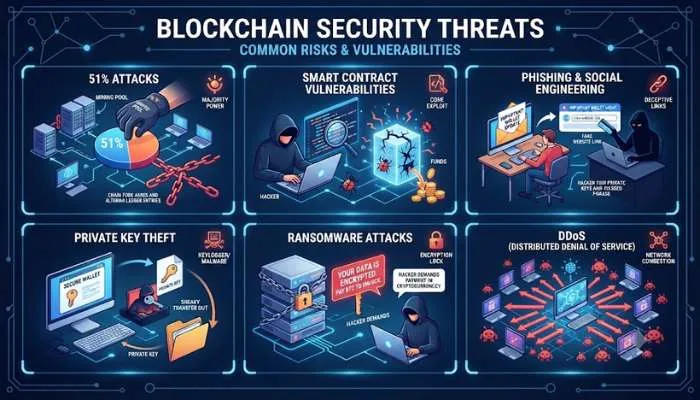
- At the network level: Public blockchains face 51% attacks. This is when a group controls more than half the mining power. Private blockchains are not vulnerable to this attack .
- At the protocol level: Smart contracts can have bugs. Reentrancy attacks and integer overflows have caused major losses. Secure development and auditing are essential .
- At the key management level: If you lose your private key, you lose your assets. If someone steals it, they control your funds. Secure key custody is critical .
- At the implementation level: Cryptographic theory does not guarantee real-world security. Implementation flaws and misconfigurations often weaken theoretical guarantees .
Common Blockchain Attacks
- Phishing: Fraudsters trick users into giving up credentials. They send fake emails that look legitimate .
- Routing attacks: Hackers intercept data as it moves between nodes. Participants cannot see the threat .
- Sybil attacks: Attackers create many fake identities to flood the network and crash it .
- 51% attacks: A group gains majority mining power and manipulates the ledger. Private blockchains are not vulnerable .
- Double-spending: This is attempted in systems with high transaction latency. Consensus and confirmations prevent it .
You May Also Read: Best Antivirus Software Features Guide for Windows 2026
Blockchain Security Certification
Security skills matter. Several certifications train professionals to audit and secure blockchain systems.
- Certified Blockchain and Cryptography for Cyber Intelligence (CBCCI) is offered through NICCS, a US government initiative. It covers blockchain applications in cybersecurity, cryptographic techniques, and security solutions .
- Certified Blockchain Security Auditor (CBSA) by Tonex is a two-day program. It covers blockchain architecture, cryptographic weaknesses, smart contract auditing, consensus vulnerabilities, and compliance frameworks like GDPR and ISO 22739 .
These certifications focus on practical skills. You learn to identify vulnerabilities and design secure blockchain systems.
The Bottom Line
Blockchain improves security through several features working together. Decentralization removes single points of failure. Immutability makes tampering detectable. Cryptography ensures authenticity. Consensus keeps everyone honest. Transparency enables auditing.
But blockchain is not automatically secure. Implementation flaws, key management risks, and privacy trade-offs remain. Security requires careful design, auditing, and ongoing vigilance. The features provide a strong foundation. The rest depends on how well you build on it.
FAQs
1. How does blockchain improve security?
No central server. Data spread across many computers. One server hacked? No big deal. The rest still hold the truth.
2. What is immutability?
Once written, it stays. You cannot change it. Try to edit an old block and the chain breaks. Everyone sees it.
3. What is a hash?
A unique code made from data. Change one letter and the code changes. That is how tampering gets caught.
4. How do digital signatures work?
You have a public key and a private key. Sign with the private one. Anyone can check it with the public one. Proves it came from you.
5. What is a consensus mechanism?
Rules for agreeing on new blocks. Proof of Work burns energy. Proof of Stake locks up crypto. Both make attacks costly.
6. Is blockchain private?
Not always. Public chains are open. Anyone can see transactions. Privacy tools exist. But permanent records clash with laws that require deletion.
7. What is blockchain security architecture?
Layers. Network handles talking. Consensus validates blocks. Data keeps integrity. Apps run smart contracts. Each layer has its own risks.
8. Are there blockchain security certifications?
Yes. CCSS covers key management. CBSA and CW3SE cover smart contract auditing and DeFi security.