Hybrid Cloud Solutions for Businesses: A Complete Guide
Businesses today face a choice. Move everything to the public cloud. Keep everything on-premises Or find a middle ground. That...
Gadgets & Technologies Are Together
India is building its own AI ecosystem. The India AI Mission latest news shows significant progress in 2026. The government has identified 20 indigenous AI model proposals for support. These include 12 Large Language Models and 8 Small Language Models . Companies like Sarvam AI, Gnani.AI, BharatGen, and Avataar AI are developing these models.
The mission has also established a shared compute facility with over 45,000 GPUs . This is creating the backbone for AI research across the country. The mission is moving fast. And it is creating real opportunities for startups and researchers.
The India AI Mission was launched in March 2024 . The Union Cabinet approved the mission with an outlay of ₹10,371.92 crore over five years . The India AI Mission is launched by which Ministry?
It is under the Ministry of Electronics and Information Technology. The mission aims to build a comprehensive AI ecosystem in the country. It focuses on creating economic opportunities and employment for youth .
Read More: Latest SaaS Industry News: Key Trends and Updates for 2026
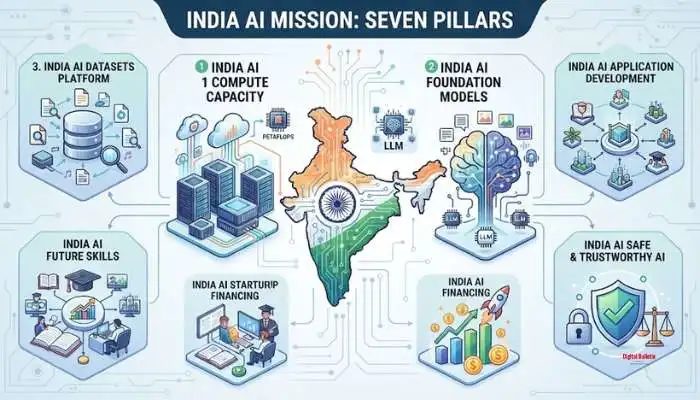
The mission has a clear structure. The India AI Mission 7 pillars cover every aspect of AI development .
1. IndiaAI Compute: This pillar builds the computing infrastructure. It has established a shared compute facility with over 45,000 GPUs . This is available to researchers, startups, and students at subsidised rates .
2. Foundation Models: This pillar supports the development of indigenous Large Language Models and Small Language Models. Twenty proposals have been identified for support. Notable models include Sarvam AI's 30 billion and 105 billion parameter models .
3. AIKosh (IndiaAI Datasets Platform): This is a unified platform for datasets, models, and tools. It now hosts over 12,500 datasets, 307 AI models, and 20 toolkits .
4. IndiaAI Application Development Initiative: This pillar supports the development of AI solutions for real-world problems. Twelve national-level hackathons have been launched. These have supported 62 AI prototypes and deployed 20 AI solutions .
5. IndiaAI FutureSkills: This pillar builds AI talent. It has awarded 686 fellowships across 178 institutions. Over 26 lakh individuals have completed the YUVA AI for All programme . Twenty-seven India Data and AI Labs have been established. Work is ongoing on 188 additional labs .
6. IndiaAI Startup Financing: This pillar provides risk capital to AI startups. It supports them from prototyping to commercialization .
7. Safe & Trusted AI: This pillar focuses on responsible AI development. It has approved 13 Responsible AI projects. These cover bias mitigation, explainable AI, privacy-preserving AI, and deepfake detection .
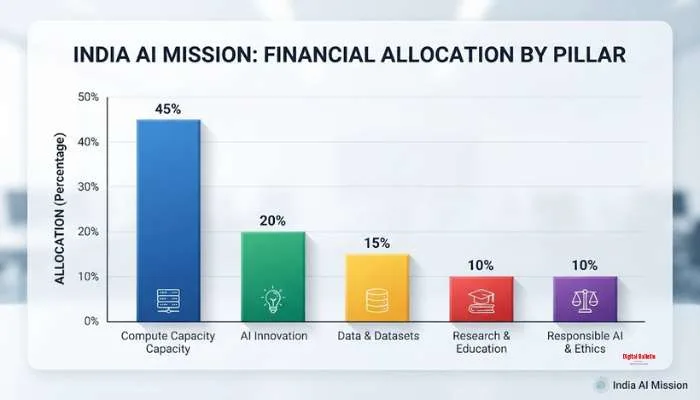
The India AI Mission funding is substantial. The total outlay is ₹10,371.92 crore . The allocation across pillars shows the priorities :
| Pillar | Allocation |
|---|---|
| Compute Capacity | ₹4,563.36 crore |
| Foundation Models | ₹1,971.37 crore |
| Startup Financing | ₹1,942.5 crore |
| Safe & Trusted AI | ₹20.46 crore |
The compute capacity gets the highest allocation. This shows the government's focus on building AI infrastructure. The Safe & Trusted AI pillar has a much smaller budget. This has raised questions about the prioritisation of safeguards .
The mission has made significant progress. Here are the key numbers as of mid-2026 .
This pillar is building trust in AI. It has approved 13 Responsible AI projects in educational institutions. These projects cover :
The India AI Governance Guidelines were released on November 5, 2025. They provide a framework for safe, responsible, and inclusive AI .
You May Also Read: Trending Government Technology News 2026: AI and Digital India

The India AI Impact Summit was held in February 2026. It was a landmark event. It brought together delegations from over 100 countries and 20 international organisations. Nearly 15 lakh participants attended physically and virtually. The summit catalysed over USD 200 billion in AI-related investment commitments .
The India AI Mission is moving fast. Twenty indigenous models are in development. A massive compute facility with 45,000 GPUs is already running. Nearly 700 fellowships have been awarded. Over 26 lakh people have been trained. The foundation is strong.
But the real work is just beginning. Can Indian startups turn this infrastructure into world-class products? Can the talent pool scale quickly enough? The government has built the backbone. Now it is up to researchers, founders, and developers to use it. The message is clear. The tools are available. The opportunities are real. India is building its AI future. And there is room for everyone who wants to be part of it.
The government has identified 20 indigenous AI model proposals for support. The mission has established a shared compute facility with over 45,000 GPUs. Fifty-eight AI Centres of Excellence are being established across states .
The India AI Mission was launched in March 2024 . The Union Cabinet approved it on March 7, 2024 .
The mission is under the Ministry of Electronics and Information Technology (MeitY) .
The seven pillars are: IndiaAI Compute, Foundation Models, AIKosh, IndiaAI Application Development Initiative, IndiaAI FutureSkills, IndiaAI Startup Financing, and Safe & Trusted AI .
The total outlay is ₹10,371.92 crore over five years . Compute Capacity gets the highest allocation at ₹4,563.36 crore .
It has supported 237 projects, awarded 686 fellowships, established 27 Data and AI Labs, and launched 12 national-level hackathons. Twenty indigenous AI models are being developed .
It is a pillar focused on responsible AI. It has approved 13 Responsible AI projects covering bias mitigation, explainable AI, privacy-preserving AI, and deepfake detection. The India AI Governance Guidelines were released in November 2025 .