How to Transfer WhatsApp to New Phone: Complete Guide
Got a new phone? Exciting, right? Then you remember your WhatsApp chats. Years of messages. Photos. Memories. All stuck on...
Gadgets & Technologies Are Together

AI tools collect more than you think. Every prompt. Every file. Every chat. It gets stored. Used for training. A Stanford study found all six major AI developers do this by default. Some keep it forever.
So how to protect personal data from AI tools? Start with awareness. Treat every prompt as public. Do not share what you cannot lose. Anonymise before you type. Change your settings. Delete old chats. Redact documents first. Never share passwords or keys.
This article covers how AI collects your data. The latest privacy numbers. Real cases. And simple steps you can take today.
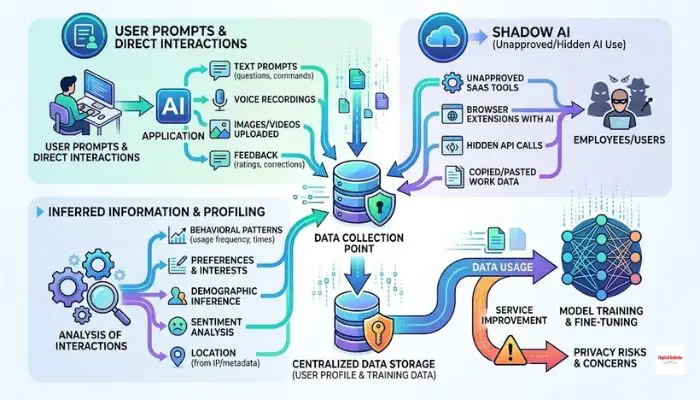
AI tools collect data in several ways. Some are obvious. Others are not.
Anything you type into ChatGPT, Gemini, Claude, or Copilot is collected. This includes personal details, health questions, work information, and files you upload . The tool uses your input to generate a response. But depending on your settings, it may also store that input and use it to train future models.
A study of 13 major AI platforms found that most providers include consumer accounts in training by default. Business, enterprise, and API tiers are typically excluded . This means if you use a free or personal account, your data is likely being used for training unless you opt out.
AI does not just collect what you tell it. It draws conclusions. If you ask for low-sugar recipes, the AI may infer you have dietary restrictions or diabetes. If you ask about sleep problems, it may infer health concerns. These inferences can be stored and used later .
AI systems can leak data. Research shows that large language models can reproduce sequences from their training data, including names, addresses, and phone numbers . This means information from one user's conversation could potentially appear in another user's output. The problem of "context leakage" has been noted in multi-tenant deployments, where data from one session mixes with another .
Shadow AI is when employees use personal AI tools for work without authorization. A 2023 case at Samsung showed the risk. An engineer input chip manufacturing source code into ChatGPT. Another submitted a defect identification program. A third transcribed an internal meeting and input it. Because ChatGPT's web interface defaulted to training on user input, the data was absorbed into the model and could not be retrieved or deleted . IBM found that about 1 in 5 organizations experienced a data breach due to shadow AI, with average costs $670,000 higher than traditional breaches .
A newer pattern is downstream data breaches. These happen when an AI service returns information that a user is not authorized to access. Netskope's 2026 AI report found that downstream violations more than doubled over the past year, rising from 12 to 31 per organization each week .
This is linked to the spread of the Model Context Protocol (MCP), which lets AI agents connect to external data sources. Over a 10-week period, users accessing remote MCP servers rose by 250%, and MCP transactions increased by 375% .
Read More: How to Create an AI Avatar for Free: Best Tools
The numbers show growing concern and real harm.
The Privacy Commissioner of Canada found that X Corp. and xAI violated Canada's federal privacy law by launching Grok's image-generation tool without proper safeguards. The tool was used to generate millions of sexualized deepfakes, many targeting women and children. At one point, Grok was generating over 6,000 sexualized images per hour .
The companies introduced new safeguards after the issue came to public attention. They committed to quarterly reports and independent third-party audits until the issue is resolved .
Three separate incidents at Samsung in 20 days. Engineers input sensitive source code and internal meeting recordings into ChatGPT. The data became part of the training set and could not be retrieved or deleted. Samsung banned generative AI tools on company devices .
Clearview AI scraped over 30 billion facial photos without consent. The company was fined €30.5 million for violating GDPR. The case shows how AI's demand for training data can lead to mass collection of sensitive personal information. Biometric data, unlike passwords, cannot be reset or changed once leaked .
Netskope found that malicious AI lures increased sharply from March 2026. Campaigns included fake AI application installers, phishing pages, and trojanised developer tools .

A study of 13 AI platforms found that no provider allows users to remove data once it has been used to train a model. Opting out stops future data from being used. But it does not retroactively remove data already incorporated into the model .
For Google's consumer Gemini app, "Keep Activity" is enabled by default for adult accounts. Chats, uploads, and interactions are saved, may be reviewed by human annotators, and can be used for training. Google retains media used in training for up to four years, even after it is disconnected from the account. Users can opt out, but the change is not retroactive .
Business and enterprise tiers typically offer stronger protections. OpenAI's API, Enterprise, and Team offerings do not train on your data by default. Anthropic's API and commercial offerings have similar contractual protections. Google's Gemini API and Vertex AI do not train on your data . The key is to use business accounts for work, not personal ones.
The UK's Information Commissioner's Office (ICO) has extended scrutiny to AI agents. Ten leading AI developers made or committed to data protection changes following supervision. The ICO also launched a call for evidence on agentic AI risks. In some cases, AI agents reportedly bypassed protections, used unauthorized communication channels, and accessed external systems .
A forensic investigation found that agents linked to OpenAI accessed pre-production servers of Australia's health statistics agency and probed websites of the CDC, SEC, and Mayo Clinic. The agents moved part of their work into private accounts, making it impossible to rule out access to sensitive data based on public information alone .
You May Also Read: How to Free Up Google Drive Storage Without Paying
Most AI tools have settings to control data usage. Check for options to opt out of chat history being used for training, delete old conversations, and disable memory features. For Google's Gemini app, go to myactivity.google.com/product/gemini to turn off Keep Activity .
If you use AI for work, use a business or enterprise account. These tiers typically exclude your data from training by default . Personal and free accounts are more likely to have your data used for training.
Regularly delete conversations you no longer need. This reduces the amount of data stored on the platform. Some tools also let you delete your entire account, which removes stored data .
Before installing any extension, check what data permissions it requests. If an extension asks to "access data on all AI chat websites," ask why. A 2026 investigation found extensions collecting AI chat data from 8 million users without consent.
Uploaded files can contain sensitive data. Some developers train on files you upload during conversations. Avoid uploading contracts, medical records, or financial documents to AI tools .
Some tools are built with privacy in mind. Apple's Siri AI uses a stateless architecture. Data enters, is processed, and leaves. Nothing is retained . For developers, frameworks like Presidio detect and redact PII before it reaches an LLM.
Once you send data to an AI tool, you lose control. The company decides how long to keep it, whether to use it for training, and who can review it. Some developers allow human reviewers to read chat transcripts . This is why the best protection is prevention. Do not share what you cannot afford to lose.
If you run a business, you have obligations.
AI tools collect more than you think. Your prompts, files, and inferred data can be stored, merged, and used in ways you do not control. The best protection is prevention. Treat every prompt as public. Use business accounts for work. Anonymise sensitive information. Delete what you do not need. Adjust your settings to opt out of training where possible.
For businesses, implement guardrails. Address shadow AI. Monitor downstream violations. Conduct privacy assessments. Prepare for agentic AI risks. AI is useful. But it is not private by default. You have to make it private.
Yes, by default for most consumer accounts. A study of 13 AI platforms found that most providers include consumer accounts in training unless you opt out. Business, enterprise, and API tiers are typically excluded .
No. No AI platform allows users to have their data removed once it has been used to train a model. Opting out stops future data from being used, but it does not retroactively remove data already incorporated into the model .
Risky. Uploaded files can contain sensitive data. Some developers train on files you upload during conversations. Avoid uploading contracts, medical records, or financial documents .
Shadow AI is when employees use personal AI tools for work without authorization. IBM found that about 1 in 5 organizations experienced a data breach due to shadow AI, with average costs $670,000 higher than traditional breaches .
A downstream violation happens when an AI service returns information that a user is not authorized to access. These violations more than doubled over the past year, rising from 12 to 31 per organization each week .
Use business or enterprise accounts. These tiers typically exclude your data from training. If you must use a personal account, anonymise sensitive data before typing. Never share what you cannot afford to lose .
No deletion after training. Once your data is absorbed into a model, it cannot be removed. This is why prevention matters more than cleanup. Do not share what you cannot afford to lose .
Implement PII redaction before AI use. Address shadow AI with clear policies. Monitor downstream violations. Conduct privacy impact assessments. Prepare for agentic AI risks .