Best AI Transcription Tool Review: Which One Should You Use?
AI transcription used to be slow. Not anymore. What took hours now takes minutes. The tools are faster. More accurate....
Gadgets & Technologies Are Together
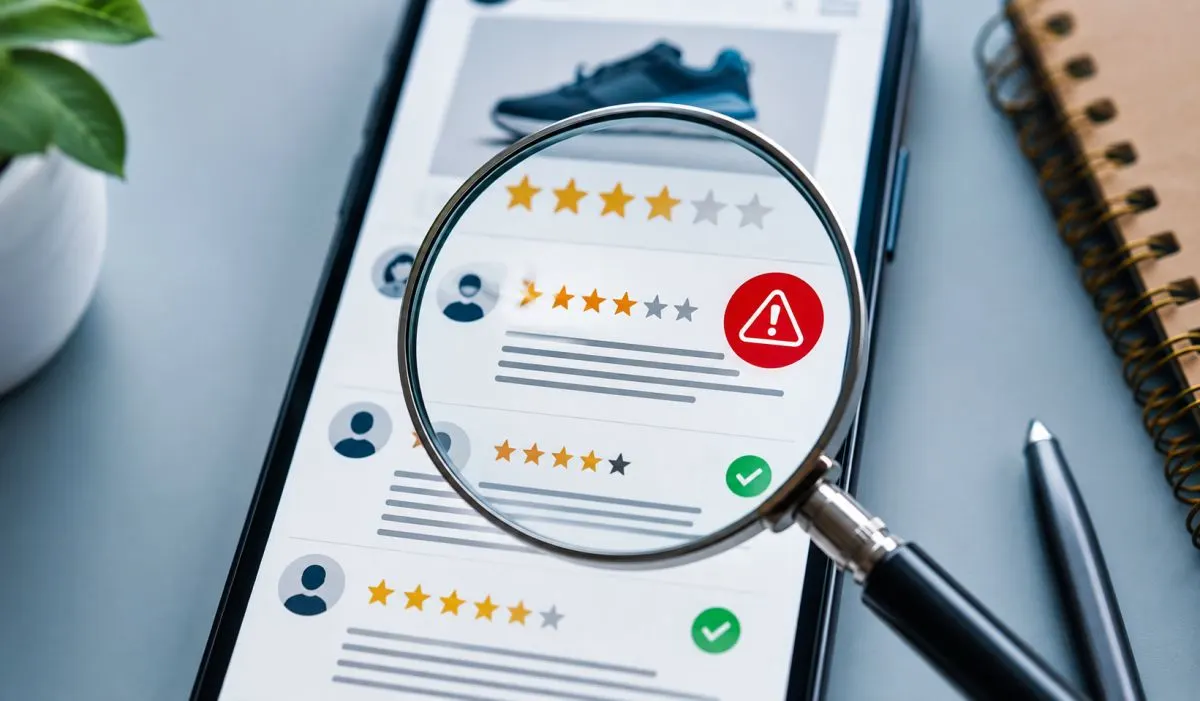
Do you trust online reviews? You should not. Fake product reviews are everywhere. They trick you into buying bad products. They waste your money and time. This guide shows you how to identify fake product reviews in simple steps. You do not need special tools. Just look for repetitive wording, review bursts in short time, generic names, and overly brief reviews.
AI is making fake reviews harder to spot. But the signs are still there. Tools like Null Fake and ReviewGuard can help. Open-source projects on GitHub also work. This guide covers everything. Read it. Learn it. Never get tricked again.
Fake reviews are a big problem. In one case, over 200,000 people were involved in a fake reviews scheme with Amazon sellers . The problem is getting worse because of AI. AI tools can write hundreds of fake reviews in minutes. They sound like real people. They use phrases like "I was skeptical, but" and "this product was a game changer" .
The FTC banned companies from buying or selling reviews in 2024 . But this rule does not stop you from being tricked. You need to know how to spot fakes yourself.
Read More: Best Gaming Console Review 2026: Top Console Picks
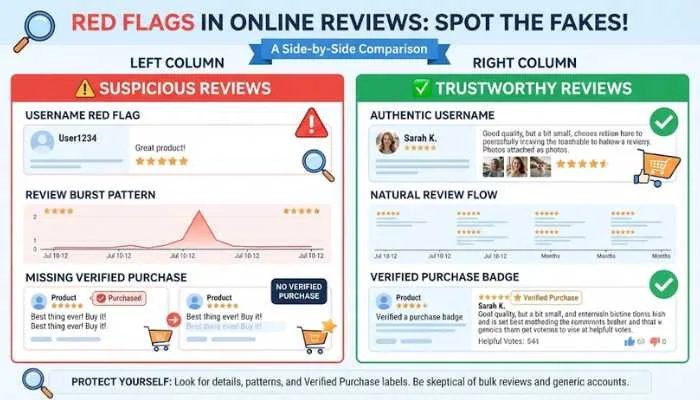
You do not need special tools to spot fake reviews. You just need to know what to look for. Here are the most common signs.
Fake reviews often use the same phrases. AI tools repeat certain sentences. Look for phrases like "I was skeptical, but" or "this product is a game changer" . If multiple reviews sound exactly the same, they are probably fake.
Real customers write reviews at different times. Fake reviews often come in a burst. If you see 10 or 15 new reviews posted in one week, that is suspicious . Especially if there were no reviews for months before that.
Check the reviewer's name. If it is something like "User1234" or just a random string of letters and numbers, that is a red flag . Fake accounts often have generic names.
Real customers usually explain why they like or dislike a product. Fake reviews are often very short. They just say "Great product" or "Five stars" with no explanation. This is a common pattern .
Some fake reviews use stock photos. Others use images that look too professional. Real customers take normal photos on their phones. If a review looks like a professional photoshoot, it is probably fake .
Some reviews pretend to be about one product but actually recommend another. These are often written by competitors. Ignore these reviews completely .
Amazon shows a Verified Purchase label for real purchases. Reviews without this label may still be real. But it is a warning sign. Some fake reviewers do get paid to buy products, so the label is not a guarantee .
AI-written reviews have a specific style. They are often overly positive. They use generic phrases. They lack specific details about the product. If a review sounds like a robot wrote it, it probably was a robot .
If a product has very few reviews compared to similar products, be careful. It might be a new scam listing. There is a chance the whole thing is a scam .
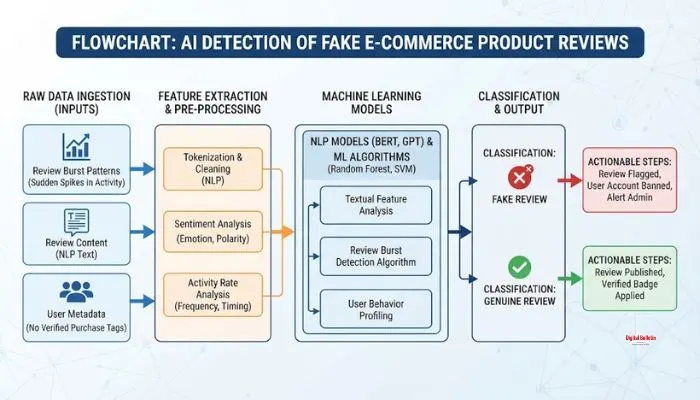
If you are a developer, you can build a fake review detector. There are open-source projects available on GitHub. Here are two good ones.
This is a machine learning-powered web application. It uses NLP to classify reviews as fake or original .
Tech Stack:
How it works:
The repository is available at: github.com/dasmrpmunna/Fake-Product-Detection-System
This is a more advanced project. It uses three types of evidence to detect fakes .
Evidence Streams:
Tech Stack:
The repository is available at: github.com/tirth1263/multi-modal-e-commerce-fake-review-detector
If you want to build something simpler, here is how to get started:
Install the transformers library:
text
pip install transformers
Use a pre-trained model to detect misinformation :
python
from transformers import pipeline

class ProductReviewMisinfoDetector:
    def __init__(self):
        self.classifier = pipeline("sentiment-analysis", model="distilbert-base-uncased-finetuned-sst-2-english")

    def detect(self, review):
        result = self.classifier(review)[0]
        return {
            "review": review,
            "label": "misinfo" if result["label"] == "NEGATIVE" else "valid",
            "score": result["score"]
        }
This is a simple version. It treats negative reviews as misinformation. More sophisticated models use TF-IDF vectorization and Logistic Regression for better accuracy .
Many old review checkers are gone. Fakespot shut down in 2025. ReviewMeta no longer loads . But new tools have replaced them.
This AI-powered review checker analyzes Amazon reviews. It assigns a reliability grade. It also adjusts the rating by removing questionable reviews.
Another AI-powered tool. It analyzes reviews for authenticity, quality, and price. It generates a number grade and adjusts the user rating. In testing, it gave a product an 8 out of 10 and adjusted the rating from 4.3 to 4.2 .
You May Also Read: Best SaaS Tools Review for Startups in 2026
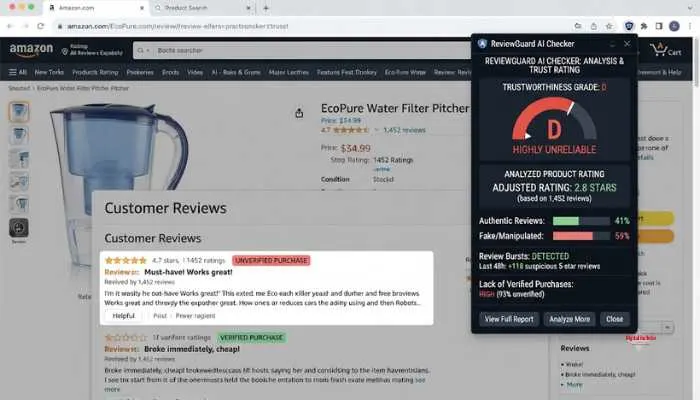
This is a browser extension. It detects fake and manipulated reviews on Amazon, Google Maps, and TripAdvisor .
Features:
Each review gets a badge: "Suspicious Review," "Uncertain," or "Looks Genuine"
Detects rating manipulation, review bombing, text similarity, and unverified purchases
Another Chrome extension. It reads reviews on any product page and gives you a letter grade. It also shows the estimated true rating after removing suspicious reviews .
Consumer Affairs expert Kyle James developed a "60-second smell test" for fake reviews . Here is how to do it.
Researchers are also working on this problem. Here are two academic approaches.
This project combines three technologies:
The system gives each product an authenticity score. It verifies supply chain data and review patterns simultaneously .
This is a simpler approach. It uses NLP to classify reviews as fake or genuine.
A web application using Flask was built. It has a responsive interface. Users submit reviews and get classification results with confidence scores .
Here are the best GitHub repositories for detecting fake reviews.
github.com/dasmrpmunna/Fake-Product-Detection-Systemgithub.com/tirth1263/multi-modal-e-commerce-fake-review-detectorgithub.com/the-developer-306/Fake-Review-DetectorAI-generated reviews are harder to spot. They sound natural. But they still have patterns.
Common signs:
Use AI detection tools:
These tools let you paste text. They give a score showing if it was written by AI or a human. But they are less reliable for short text like reviews .
If you find a fake review, report it. The platform will investigate and possibly remove it.
On Amazon:
| Red Flag | What To Look For |
|---|---|
| Repetitive wording | Same phrases in multiple reviews |
| Review bursts | 10+ reviews in one week |
| Generic names | "User1234" or random characters |
| Brief reviews | No specific product details |
| Stock photos | Overly staged or professional images |
| Competitor plugs | Reviews recommending other products |
| Missing verified badge | No Verified Purchase label |
| AI style | Overly positive, lacks specifics |
| Low review count | Few reviews compared to similar products |
Check for repetitive wording, review bursts, generic names, and overly brief reviews. Also click on reviewer names to check their history. Use the 60-second smell test from Consumer Affairs .
Null Fake and FakeFind are good options. Null Fake analyzes Amazon reviews and adjusts the rating. ReviewGuard and ReviewVigil are Chrome extensions that work on multiple sites .
You can use NLP with Scikit-learn. Train a model using TF-IDF vectorization and Logistic Regression. There are open-source projects available on GitHub .
No. Fakespot shut down in 2025. ReviewMeta is also gone. Null Fake and FakeFind have replaced them .
Search for "fake review detector" on GitHub. Good repositories include FraudFilter, Multi-Modal Fake Review Detector, and Fake Review Detector .